

Whether you're just starting out in a multiage classroom or refining a structure you've been using for years, this guide will help you find or fine-tune the instructional route that works best for your students.
One of the most common questions teachers ask when they step into a multiage math classroom is: How do I actually structure the time? Do both grades do everything together? Do I split them for the main lesson? How much togetherness is too much or not enough?
The answer isn't one-size-fits-all. It depends on your content, your students, and where you are in building your multiage practice. That's why we think about the multiage math block as a spectrum with four distinct routes, ranging from fully blended to fully separate.
Here's what each route looks like, when it works best, and how to decide which one is right for you right now.
The Routes at a Glance
Every route shares the same four-part math block: Launch, Main Lesson, Menu, and Closure, but differs in how much of that time the two grades spend together versus apart. The further down you move on this list, the more grade-level separation there is. The further up, the more shared experience.
Neither end of the list is inherently better. The goal is to match your route to your content and your students and to know you can shift routes from unit to unit as needed.
Route 1: Fully Blended
One shared experience, differentiation lives in menu
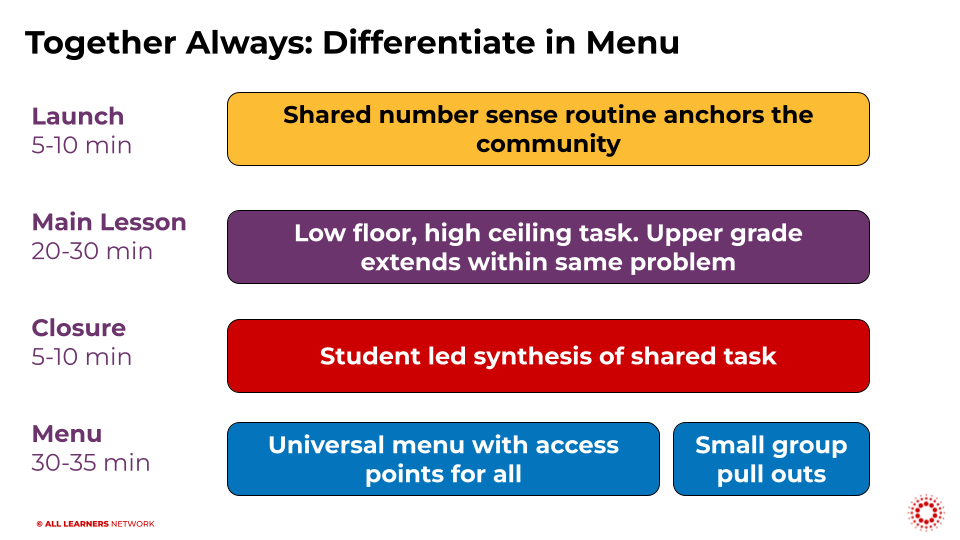
In Route 1, both grades move through the entire math block together. The Launch is shared, the Main Lesson uses a single task that both grades engage with, and Closure brings everyone back together to share thinking. Differentiation happens primarily during Menu, where upper-grade pull-outs are clustered later in the unit.
The key to making this work is low-floor, high-ceiling task design, tasks that every student can enter and that naturally extend for the upper grade without requiring a separate activity. The upper grade isn't doing a different task; they're going deeper into the same one.
- Community-building is strongest here, students experience themselves as one class
- Works best when content strands genuinely overlap across both grades
- Pull-outs happen during Menu only, shared learning time is never interrupted
- Strongest community
- Least complex planning
- Rich cross grade level discourse
- Requires careful task selection
Best when: Content strands overlap naturally across both grades and tasks have high ceilings. This is the default choice when it's possible and the most powerful route for building a true multiage community.
Route 2: Mostly Together
Shared most days, split when content truly diverges
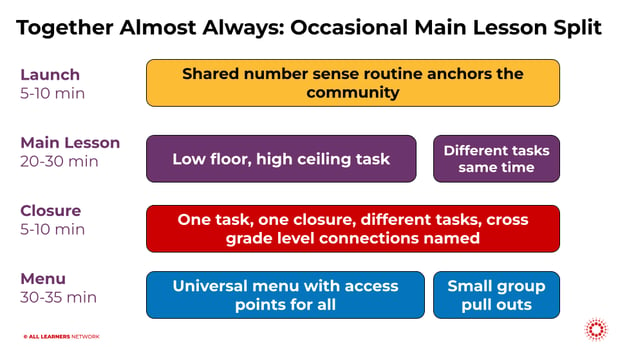
Route 2 looks a lot like Route 1 most of the time. Launch and closure are always shared and the main lesson is together roughly 70-80% of days. When the content genuinely forks, the class splits for the main lesson only, with each grade working on a different task simultaneously.
The split is intentional, not the default. It is triggered by a specific content need, not by habit or convenience. On split days, the launch still builds shared content, and closure reconvenes both grades to share strategies across tasks.
- Preserves community as the norm while building in flexibility
- Requires two tasks ready on split days (adds some planning load) and stronger facilitation skills are required from the teacher anticipating and supporting students during split days.
- Students need strong enough routines to self manage during split lessons.
- Preserves community and is flexible.
- Handles content forks gracefully.
Best when: Most of the unit overlaps but 3-5 lessons require genuinely different grade level work. You want community as the default with flexibility built in.
Route 3: Mostly Split
Shared entry point, separate deep dives
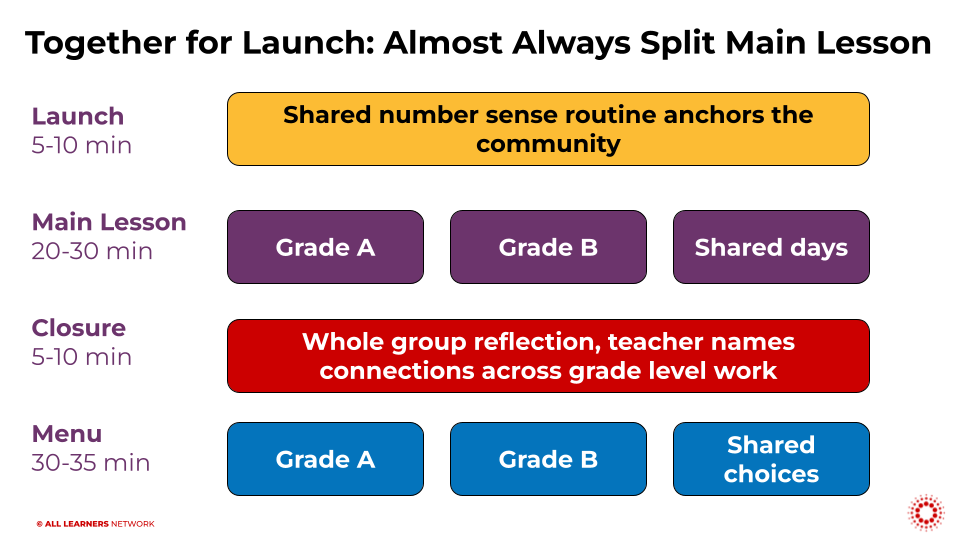
In route 3, the launch and closure are the community anchors, a shared number sense routine that both grades can access. The main lesson is almost always split (80-90% of days), with each grade focusing on a different grade level task while the teacher rotates between groups.
This route requires a great deal of student independence during main lesson. One grade is actively working with the teacher while the other works on their own. Occasional together days are used strategically, for high interest tasks or moments where connecting across grades adds value.
- Launch and closure are the daily community moments, don’t underestimate their power.
- Teacher can focus on one grade at a time during main lesson (assuming the other grade can work independently from the teacher)
- Works well when content strands are parallel but not overlapping
- High planning load, two tasks daily
- Requires strong student independence.
Best when: Content strands are grade specific with little natural overlap, but you still want a daily shared community moment. Students have strong enough routines to work independently during the main lesson.
Route 4: Fully Separate
Two classrooms in one room
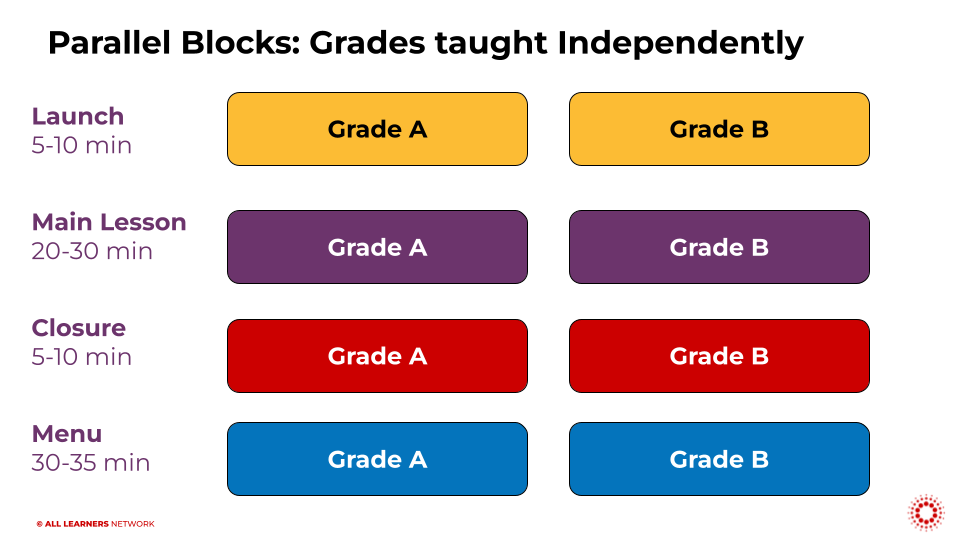
Route 4 is the most separated option. Launch, main lesson and closure are all grade specific. Students have little to no shared experience and require different menu options. The teacher is essentially running two parallel classrooms simultaneously. One grade is active while the other works independently, and then they switch.
This route offers maximum grade level fidelity but it comes at a big cost, the relational and discourse benefits of multiage grouping are lost. There are no shared community moments and the planning and management demand is the highest of all four routes. Teachers lose the ability to have small group instruction during menu time because they are always doing tier 1 instruction.
- Often the first thing new multiage teachers try
- Most teachers find this unsustainable long term.
- Students identify primarily with their grade cohort, not the multiage community.
- Highest planning load for teachers.
- Small group instruction is lost.
- Less flexibility in instructional time, which can lead to fewer instructional minutes for every student.
Best when: Content is completely unrelated across grades AND grade level fidelity is the top priority. Use sparingly, this is the least integrated option and not the long term goal.
The Route is a Tool, Not a Rule
One of the most important things to understand about these four routes is that they’re not a hierarchy, they are tools. The goal is to match the route to the content and the moment, and to feel confident moving between them as your units and your students evolve.
Experienced multiage teachers often find themselves using two or three different routes across a single school year, and sometimes shifting mid-unit when the content calls for it. That kind of responsiveness is a sign of a strong multiage practice, not inconsistency.
Printable concept map of these routes
What Now?
-
Doing Math Together: How to Lower the Floor and Raise the Ceiling Across the Multiage Math Block — Once you’ve picked a route, you need tasks that work for both grades. This post shares three moves for building one shared experience across Launch, Main Lesson, Closure, and Menu. Read it to start designing tasks every learner can enter and extend.
- All Learners Lesson Structure — Every route in this post is built on the same four parts: Launch, Main Lesson, Menu, and Closure. Explore the All Learners Lesson Structure to see how each part supports inclusion and differentiation, whichever route you choose.
- Seven Closure Activities for Your Math Block — In most routes, Closure is where the two grades come back together. This post shares seven strategies for wrapping up a lesson with connection and reflection. Read it to find a closure routine that fits your multiage block.
- Bring All Learners Network to Your School or District — Ready to bring AI Math Coach, and everything else ALN offers, into your building? Book a call with our team to talk through what embedded professional development could look like for your school or district.

All Learners Network is committed to supporting pedagogy so that all students can access quality math instruction. We do this through our online platform, free resources, events, and embedded professional development. Learn more about how we work with schools and districts here.
No Comments Yet
Let us know what you think