.png?width=2000&height=675&name=2023%20ALN_standard-red%20(3).png "All Learners Network logo")
Published: November 1, 2024
Educational systems are one of the many structures that have been built with a certain set of identities in mind. When we revise these structures to welcome and include a broader set of identities - everybody benefits. Think about curb cuts on a sidewalk leading up to a school. When those curb cuts exist, utilizing the sidewalks becomes accessible for wheelchairs, but also for people pushing strollers, riding bikes, pulling rolling suitcases, using canes or other mobility devices, and more. This concept of making improvements that result in broader access to inclusion and access is called the Curb-Cut Effect - a term coined by PolicyLink founder, Angela Glover Blackwell.
In a Stanford Social Innovation Review article, Glover Blackwell explains that “curb-cut thinking is animated by the idea of equity. This should not be confused with the formal legal equality conferred by landmark laws such as the Civil Rights Act. Equality gives everyone the right to ride on the bus. Equity ensures that there are curb cuts so people in wheelchairs can get to the bus stop and lifts so they can get on the bus, and ensures that there are bus lines where people need them so they can get to wherever they need to go. Equity means promoting just and fair inclusion throughout society and creating the conditions in which everyone can participate, prosper, and reach [their] full potential.”
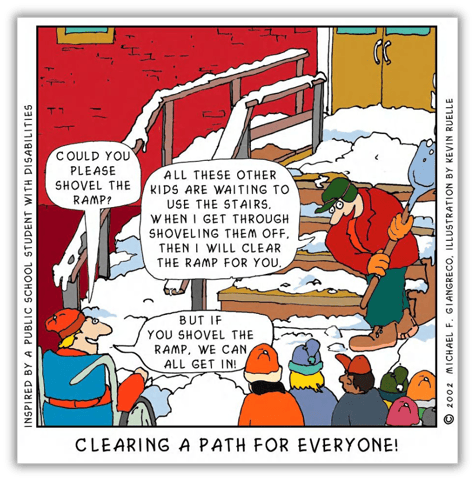
When we think about designing lessons or classrooms, we need to think about who we are designing them for. Consider the Clearing a Path for Everyone cartoon by The University of Vermont Professor Emeritus of Special Education, Dr. Michael Giangreco, and Illustrator Kevin Ruelle. When the ramps are cleared first, all students have access to the school. By clearing the ramp first, nobody has to wait to access their learning. The person shoveling in the cartoon - is probably well-intentioned and serves as a reminder that we need to be thinking about the ways we might be making students wait or even entirely preventing them from being able to access their learning.
When we honor our students and all of the identities that they carry - we create an environment where all students can learn. And we know that our students all hold multiple identities. This is why we need to consider intersectionality when thinking about access to math education. Now, intersectionality is not just the existence of a multitude of identities. As humans, we all have multiple identities, and those identities intersect and overlap. Those identities impact our experiences and those experiences impact how we see and navigate the world.
Intersectionality is a lens to see how multiple marginalized and oppressed identities overlap. Kimberlé Crenshaw originally coined the phrase in the 1980s. She provided intersectionality as a specific way to examine oppression and the way people of multiple marginalized identities are impacted by the unique experience of having multiple oppressed or marginalized identities.
“Intersectionality is a lens through which you can see where power comes and collides, where it interlocks and intersects. It’s not simply that there’s a race problem here, a gender problem here, and a class or LBGTQ problem there. Many times that framework erases what happens to people who are subject to all of these things.”
When considering intersectionality and math classrooms - think about the unique experiences our learners face when they carry with them multiple layers of disadvantage based on the systems they occupy. A Black student living in poverty with an IEP has a different number of marginalized identities than a white student with an IEP, not living in poverty. Of course, we know that not understanding our students’ identities and not fully seeing them as mathematicians creates a lack of a sense of belonging in math class. Math identity is an important part of intersectionality. How we perceive our abilities to do math is an IDENTITY we hold, not just a belief. And that identity impacts how we show up in math class, and really in the world in relation to doing and thinking about math.
Belonging is required for students to show up to math class with the ability to be vulnerable and share their thinking. Every single thing we do at All Learners Network (ALN) is centered around making sure all students have access to quality, engaging, inclusive math instruction. We know how critical it is to make sure that every single student is included in our math lessons, especially students who are facing multiple marginalized identities. There are plenty of systems that will unfortunately further oppress them, but we know math class does not need to be one of them. By making changes to our classrooms and practice so that all students can access high-quality math instruction, we are making sure math class is not another oppressive environment for our students.
Click here for the printable version.
What Now?
1. Review Dr. Lateefah Id-Deen’s Edutopia article, Making Math Classes More Welcoming for Black Students.
2. Use the All Learners Lesson Structure as a framework for creating your balanced math block so that all students can be included in your math lesson.
3. Bring All Learners Network (ALN) into your school or district for embedded professional development.
All Learners Network is committed to a new type of math instruction. We focus on supporting pedagogy so that all students can access quality math instruction. We do this through our online platform, free resources, events, and embedded professional development. Learn more about how we work with schools and districts here.
Erin’s Soccer Series, Part 3: The Soccer Club and Systemic Support
The Stars Debate


No Comments Yet
Let us know what you think