.png?width=2000&height=675&name=2023%20ALN_standard-red%20(3).png "All Learners Network logo")

Can your students say a number, write a number, and show what a number actually means and move fluidly between all three? If there's a gap anywhere in that triangle, that's where number sense breaks down. The good news? You can do something about it today.
Whether you're teaching kindergartners to count collections or eighth graders to reason about functions, the same fundamental question applies: Do my students truly understand the numbers they're working with? Not just "can they compute with them" but “do they really get them?”
The Numeracy Triangle framework, adapted from the work of John Van de Walle and colleagues, gives us a beautifully simple lens for answering that question and for doing something about it when the answer is "not quite yet."
What is the Numeracy Triangle?
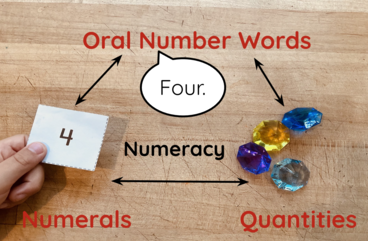 The idea is straightforward: for any type of number, true understanding lives at the intersection of three things.
Oral Number Words
How we say and talk about a number; the language we use to describe it.
Numerals & Symbols
The written symbolic form, digits, fractions, equations, and expressions.
Quantities & Representations
Physical or visual models that show what the number actually means.
A student who truly understands a number can move fluidly between all three corners of the triangle. They can look at tens frames showing 14 objects and say "ten and four more" and write 14. If they hear the number 14, they can write the numeral and show 14 fingers. When you give them one of the representations, they can give you the other two.
The Diagnostic Power of the Triangle
When a student is struggling, the triangle tells you where the gap is. Can they say it but not show it? Can they write it but not explain it? Can they build a model but not connect it to the symbol? Each of those is a different instructional move. You are not just asking “do they get it,” you are asking “what connection is missing?”
How this Looks Across Grade Levels
The triangle applies to every number type students encounter from kindergarten through middle school. Here's what it looks like in practice at each level and the kinds of questions that help students make the connections themselves.
Grades K-2 Whole Numbers & Place Value
Young students often learn to say numbers and write numerals before they have any real sense of what those numbers mean as quantities. The triangle reminds us to close that loop.
Example: The number 45
Oral: “Forty-five” but also “four tens and five ones” or “forty and five more”
Symbol: 45, or 40 + 5 or 30 + 15
Quantity: Represented with base ten blocks, number paths, ten frames, unifix cubes
Questions that build connections
- You wrote 45, can you build that with blocks? How many tens did you use?
- I see you made 4 tens and 5 ones. How would you say that number out loud?
- Can you show me 45 in a different way? Is there another way to group these blocks?
- What does the 4 in 45 actually mean? Can you show me with your blocks?
Grades 3-5 Fractions
Students often struggle with fractions and one common misconception is around students understanding that 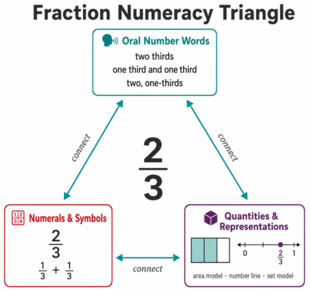 fractions are numbers. Understanding fractions within the numeracy triangle is essential and gaps become the most visible. Students can often write ⅔ and say “two thirds” without having any real sense of what that quantity looks like or means. This is complicated by the fact that fraction notation uses two numerals (a numerator and denominator). The symbol-quantity connection is the one that most students need support in building.
Example: The fraction ⅔
Oral: “two thirds” but also “one third and one third” or “two, one-thirds”
Symbol: ⅔ or ⅓ + ⅓
Quantity: An area model with 2 one third parts shaded, a number line showing ⅔ as a distance from 0, a set of 2 out of 3 objects
Questions that build connections
- You wrote ⅔, can you draw a picture that shows what that means?
- Where does ⅔ belong on this number line? How do you know?
- You said “two thirds”, what does the 3 in that fraction actually tell us?
- Is ⅔ closer to 0, ½ or 1? How could you show that?
Grades 4 & 5 Decimals
Decimals are a place where students often get the symbol right, the oral language wrong, and the quantity connection is almost entirely missing. Using language such as "point six two" is not as beneficial as "sixty-two hundredths," and that difference matters enormously for developing understanding of place value.
Example: The decimal 0.62
Oral: “sixty-two hundredths" (not “point six two”)
Symbol: 0.62, or .62, or 62/100, or 0.6+0.02
Quantity: A hundredths grid with 62 squares shaded, a number line showing 62 hundredths as a location between 0 and 1
Questions that build connections
- How would you say 0.62 out loud, in a way that tells us about its place value?
- Can you shade a hundredths grid to show me 0.62? How many squares is that?
- Is 0.62 closer to ½ or 1? How do you know?
- What is the same about six tenths and sixty-two hundredths? What is different?
Grades 6-8 Functions and Algebraic Expressions
By middle school, the quantity corner of the triangle shifts to graphs, tables and visual representations of relationships. Students who can write y = x² but can’t sketch its shape, or who can read a graph but can’t write its equation are missing critical connections that will follow them into high school math.
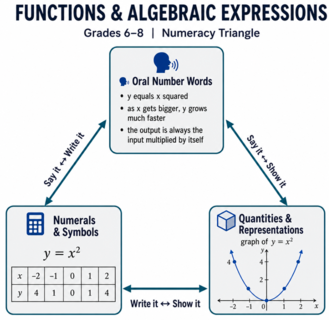 Example: The function y = X²
Oral: “y equals x squared” but also “as x gets bigger, y grows much faster” or “this is a relationship where the output is always the input multiplied by itself”
Symbol: y = x² or a table of values
Quantity: a parabola on a coordinate plane, a table showing input/output pairs
Questions that build connections
- You graphed this function, can you write the equation that matches it?
- What does x² actually mean? Can you show me with a table of values?
- How is y-x² different from y=2x? What does each one look like?
- If x doubles, what happens to y? Does that surprise you?
How this Looks Across Grade Levels
Make “show it 3 ways” a habit
Whatever number type you're working on, regularly ask students to represent it in all three corners of the triangle. This doesn't have to be a big production, even a quick exit ticket that says, "Write it, say it, show it," builds the habit of connecting all three representations over time.
Listen for the language
Pay close attention to how students talk about numbers. "Point six two" instead of "sixty-two hundredths." "Two over three" instead of "two thirds." These aren't just pronunciation issues, they're windows into whether the oral corner of the triangle is connected to meaning. Gently redirecting language is one of the highest-leverage moves you can make.
Ask “what does that look like?”
Whenever a student writes or says a number, make it a reflex to ask: "Can you show me what that looks like?" And whenever a student builds or draws a model, ask: "How would you write that? How would you say it?" These two questions, asked consistently, do more to build the triangle than almost any structured lesson.
The Bottom Line
Number sense isn't a mysterious quality that some students have and others don't. It's the result of building strong connections between oral language, symbols, and quantities, over and over again, across every number type students encounter.
The Numeracy Triangle doesn't tell you what to teach. It tells you how to look at what your students understand, and ask the right questions to help them make connections within the numeracy framework.
What Now?
-
More Than Tens and Ones. Supporting Students’ Place Value Understanding — See AI Math Coach in action before you try it yourself. This demo walks through both assistants, Pedagogy and Intervention, so you know exactly what to expect.
- High Leverage Concepts — The Numeracy Triangle shows you where a student’s understanding breaks down. The HLC Progressions show you what to build next, from kindergarten number sense through middle school algebra. Download them to plan your next instructional move with a clear view of where your students are headed.
- Founder’s Corner: Beyond the Right Answer: The Conditions that Lead to Real Understanding — Three fifth graders add ½ + ⅓ correctly, then say 3/6 is greater than ½. Dr. John Tapper shares what that moment revealed about the gap between knowing the steps and understanding the math. Read the full story to see what it takes to close that gap.
- Bring All Learners Network to Your School or District — Ready to bring AI Math Coach, and everything else ALN offers, into your building? Book a call with our team to talk through what embedded professional development could look like for your school or district.
All Learners Network is committed to supporting pedagogy so that all students can access quality math instruction. We do this through our online platform, free resources, events, and embedded professional development. Learn more about how we work with schools and districts here.

No Comments Yet
Let us know what you think