.png?width=2000&height=675&name=2023%20ALN_standard-red%20(3).png "All Learners Network logo")

What is the difference between a student who gets the right answer and a student who understands the mathematics? The answer lies in how flexibly they can move between different ways of representing mathematical ideas and how well they understand the connections between those representations.
The Problem: Procedures Without Understanding
Research tells us that the most common cause for math struggles is students applying procedures without understanding the underlying concept. This happens when students don’t have developed conceptual models, when they have been rushed too quickly from concrete experiences to abstract symbols without building the critical bridges between different representations.
Studies of effective math instruction demonstrate that students need plenty of time in each stage of the learning progression to develop solid mental models (Butler, Miller, Crehan, Babbit & Pierce, 2003). In our instruction, we need to provide students more time with concrete models before expecting them to be able to work with representations and symbols.
The CRA Progression is Fluid, Not Linear
One of the most important insights about the CRA progression is that it is not a one way street. Students don’t move from concrete to representational to abstract and stay there. Instead, they move back and forth between model types as they build understanding.
The progression is also not age dependent. A fifth grader learning about fractions for the first time needs concrete experiences, just as much as a kindergartener learning about counting (Bruner, 1966). The key is matching the model type to where the student is in understanding that particular concept.
Understanding is strengthened when students can approach a concept with multiple models and make explicit connections between them (Lesh, Post & Behr, 1987). Our job as teachers is to help students build those bridges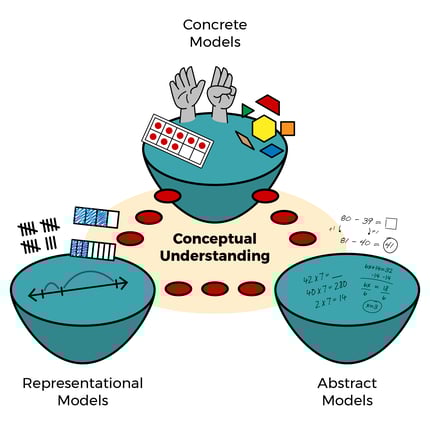
What This Looks Like in Practice
Let’s consider a problem that works well across grade levels.
The school is ordering pizza for a celebration. We need enough pizza so that each student can have three slices. There are 28 students in the class. Pizza comes in boxes of 8 slices each. How many boxes of pizza do we need to order?
Concrete Model
Students use manipulatives such as counters, cubes, base ten pieces or tiles to physically represent the problem. They might create 28 groups of 3, or use different colored manipulatives to represent students and slices. Students might build an equal groups model or an array. The key is that they can touch, move and rearrange physical objects to explore the mathematical relationships.
Representational Model
Students create a drawn representation that might look like circles with three slices in each, an array, a number line showing jumps of 3 or a diagram. This representation should capture the math structure but doesn’t require physical objects. Critically, this should look different from simply photographing the concrete model, it is a translation of the math idea into a visual format. Representational models often look like concrete models but are simplified or abstracted versions.
Abstract Model
Students write equations to solve the problem, perhaps 28X3 to find total slices, then dividing by 8 to find number of boxes. At this level, the context and visuals are gone, it is pure symbol manipulation.
Making the Connections Visible
The real learning happens when we help students see how the same mathematical idea lives across all three representations. The ability to translate between different representational forms is a key indicator of conceptual understanding (Lesh, Post & Behr, 1987). Here are some powerful questions to help students build those bridges.
- Can you show me with the blocks what your drawing represents?
- Where do you see the number in your equation show up in your drawing?
- What does this part of your equation mean in the context of the story?
- How would this look if you used a different model?
These bridging questions make students’ thinking visible and help them articulate the through line between representations.
Instructional Strategies to Support Student Movement Between Models
Make Thinking Visible Through Comparison
Display multiple student solutions side by side and facilitate a discussion about what is the same and what is different. Have students solve with one model then ask: “How would this look if you used a different model?
Use Bridging Questions
Rather than explaining connections yourself, ask questions that help students discover the relationships
- Where is the element from your drawing in your equation?
- Show me what this number means using the manipulatives.
- What is happening mathematically in both of these solutions?
Start Concrete, Then Connect Back
When introducing new concepts, always begin with concrete experiences (Witzel, 2005). As students move toward abstract work, continually ask them to connect back; “Remember when we used the base ten blocks? What was happening there?” This helps students anchor abstract symbols to concrete meaning.
Allow and Normalize Flexible Movement
If a student is stuck with an equation, explicitly invite them to use manipulatives or draw a picture. Frame this as what mathematicians do. “Mathematicians use different models depending on what helps them think! Let’s try representing this problem in a different way!” This removes any stigma from going back to concrete models.
Create Regular Opportunities for Multiple Representations
Build time into lessons for students to represent their thinking in multiple ways. Use journal prompts like “show three different ways to solve this problem” or “draw a picture that matches this equation.” Make multiple representations an expected part of your math practice, not just an occasional add on.
Things to Avoid
As we support students in moving between models, it is important to be aware of some common pitfalls.
Rushing too quickly to abstract: Give students plenty of time with concrete and representational models (Butler Et al, 2003). The understanding built here is the foundation for flexible, meaningful work with abstract symbols.
Treating Models as Age Dependent: Do not assume older students do not need concrete experiences with new concepts (Bruner, 1966). Match the model to the concept and the student’s understanding, not their age.
Showing Connections Rather Than Eliciting Them: Resist the urge to explain how the models connect. Instead, use questions to help students discover and articulate these connections themselves.
Using Representational Models that are too Complex: Sometimes our drawn representations become as complex as concrete models. Help students learn to create simplified representations that capture the math structure without every detail.
Key Takeaways
- The CRA progression is fluid and recursive, students move back and forth as they develop understanding.
- Understanding deepens when students can work flexibly across multiple models and articulate the connections between them.
- Our role is to build bridges between models through questioning, comparison, and explicit connection making
- Concrete experiences are essential for all students learning new concepts, regardless of age.
- Movement between models should be normalized and encouraged, not seen as going backwards.
Try This Tomorrow
Choose one problem in your upcoming math lesson. Plan how you will...
- Provide access to concrete materials for students who want them
- Ask at least two bridging questions that help students connect different representations
- Create space for students to see and discuss multiple solutions side by side
Notice what happens to the depth of mathematical conversations in your classroom when you make these connections explicit. The through line between models is not just about moving from concrete to abstract, it is about building deep, flexible mathematical understanding that students can access and apply in multiple ways.
References
Bruner, J. S. (1966). Toward a theory of instruction. Cambridge, MA: Harvard University Press.
Butler, F. M., Miller, S. P., Crehan, K., Babbitt, B., & Pierce, T. (2003). Fraction instruction for students with mathematics disabilities: Comparing two teaching sequences. Learning Disabilities Research & Practice, 18(2), 99-111.
Lesh, R., Post, T., & Behr, M. (1987). Representations and translations among representations in mathematics learning and problem solving. In C. Janvier (Ed.), Problems of representation in the teaching and learning of mathematics (pp. 33-40). Hillsdale, NJ: Erlbaum.
Witzel, B. S. (2005). Using CRA to teach algebra to students with math difficulties in inclusive settings. Learning Disabilities: A Contemporary Journal, 3(2), 49-60.
Witzel, B. S., Mercer, C. D., & Miller, M. D. (2003). Teaching algebra to students with learning difficulties: An investigation of an explicit instruction model. Learning Disabilities Research & Practice, 18(2), 121-131.
What Now?
- Download this resource the author created for educators in need of bridging questions: Student Connection Questions in CRA Cycle
- Read this article next: Models & Manipulatives: Turning Mathematical Ideas Into Concrete Experiences
- Learn how ALN's AI Math Coach can curate ideas for models and manipulations to use with your classroom.
- Bring All Learners Network (ALN) to your school or district for embedded professional development.

All Learners Network is committed to supporting pedagogy so that all students can access quality math instruction. We do this through our online platform, free resources, events, and embedded professional development. Learn more about how we work with schools and districts here.
Understanding MTSS vs. Tiered Classrooms
Look Back to Look Forward



No Comments Yet
Let us know what you think