.png?width=2000&height=675&name=2023%20ALN_standard-red%20(3).png "All Learners Network logo")

Every other week, our founder and CEO, John Tapper, will share what's on his mind, from his thoughts on math education to what's been inspiring him lately. This is your chance to hear directly from the person who started it all. We believe great ideas are worth sharing, and Founder's Corner is our way of bringing you closer to the heart of All Learners Network (ALN) and the passion that drives everything we do.
Paulo Coelho once wrote, “People never learn by being told. They have to find out for themselves.”
After forty years in mathematics education, I can tell you he’s right. And he’s captured the central challenge every math teacher faces.
Think about the difference between being told that 3/4 is greater than 2/3 versus figuring it out yourself by comparing fraction models. When someone tells you the answer, you might memorize it, repeat it on a test, or even believe it. But you don’t truly know it, because it isn’t your thinking. You borrowed someone else’s.
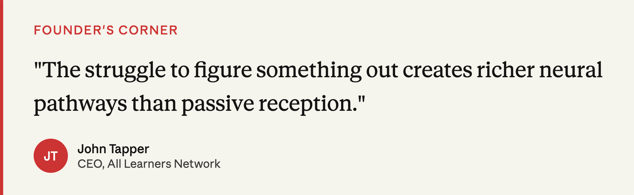
Real learning happens when students wrestle with ideas themselves and make them their own through experience and inquiry. This isn’t just pedagogical theory. It’s how our brains actually work. The struggle to figure something out creates richer neural pathways than passive reception.
Each wrong turn, each correction, each moment of confusion followed by clarity – these are the experiences that wire understanding into our thinking.
Mathematics is Not a Spectator Sport
In Zen practice, there is a saying: no amount of description conveys what zazen actually is. You have to sit. When you are thirsty, you don’t want the idea of water. You want the real thing.
The same is true in mathematics. No amount of explaining fractions conveys what they actually are. Students have to work with them, manipulate them, and make sense of them.
This principle is often misunderstood. There is a persistent idea that student-led discovery means the teacher hands students a problem and says, “Go invent math!” That’s not what happens! Supporting students to make mathematical discoveries requires a much more nuanced and sophisticated understanding of both math and teaching.It led me to what I call ‘Rigorous Scaffolded Inquiry.’ The teacher’s job isn’t to tell students how to solve problems, but it’s not to abandon them either. A teacher’s role is to engineer the environment: the launch, the questions, the tools, the scaffolds — so that genuine discovery becomes possible for every learner.
Teachers create the conditions where finding out can happen. This means launching genuinely problematic tasks, where the path forward isn’t obvious. It means asking questions that provoke thinking rather than lead to predetermined answers. It means providing scaffolds (manipulatives, visual models, and simpler parallel problems) that give students access to mathematics without removing the cognitive demand.
What Happens When We Just Tell
Traditional math instruction relies heavily on telling: Here’s the procedure. Watch me do it. Now you practice. This approach fails most students, especially those with learning differences, because it bypasses the sense-making that creates real understanding. When students learn to mimic without understanding, they become anxious because they're always one forgotten step away from being wrong. They come to believe that mathematics is about memorizing rules rather than making sense of quantities and relationships.
Worse, when we just tell students what they should think or how they should think, we rob them of agency. The mathematical ideas belong to the teacher, the textbook, the curriculum, but never to the students themselves. There's no ownership, no intrinsic motivation, just compliance.
This is when we should channel Coelho: People never learn when they are told.
Yes, some things can only be done with direct instruction: mathematical vocabulary, notation conventions, and historical context. Students won’t invent mathematical symbols or conventions. How could they? These come from culture.
But the understanding of mathematics itself? This is earned through experience. This principle shapes everything we do at All Learners Network.
%20(1).png?width=1200&height=627&name=Hero%20Images%20(WebsiteBlogEmails)%20(1).png)
How We Build These Conditions at ALN
Our professional development isn't just a workshop teachers attend and forget. It's sustained engagement with ideas: building content knowledge over time, getting feedback tied to what's actually happening in your classroom, and developing the pedagogical confidence to let student thinking lead a lesson rather than derail it. We work alongside teachers, not above them. We create the conditions in which educators can find out, just as we ask them to create those conditions for students.
As generative AI evolves, we have taken our core approach and refined it over two years to create AI Math Coach, not to tell teachers what to do, but to help them think. It asks the questions a good instructional coach would ask: What do you notice about this student's thinking? What might you try next?
It doesn't replace the human work of teaching. It extends it.
The difference is profound. Traditional AI tutors often say, “Here’s how you solve this.” Ours asks, “What if you tried it with smaller numbers first?” or “Could you draw a picture of what’s happening?” It creates space for discovery while ensuring that discovery is accessible to every student, regardless of their starting point or learning difference.
The Moment Everything Clicks
There’s a particular kind of joy that comes from discovering something yourself – that “aha!” moment when the pieces click together. I’ve seen it thousands of times in students’ faces. It’s the look of someone who hasn’t just learned a fact, but who has genuinely understood something new about how the world works.
That’s what Coelho is pointing toward. And, after forty years of teaching, here’s what I know: It’s not rare, and it's not reserved for students. When a teacher believes and knows how to build the conditions for deep, meaningful mathematics, every student can succeed.
What drives my work at ALN are these “a-ha” moments for adults and students. Not the theory, but the faces. Every time I see a teacher shift - from hoping their students can do math to knowing they can - I know that somewhere down the hall, a student is about to have that “a-ha” moment too,
Let’s help everyone learn math differently by helping them discover it themselves.
What Now?
- Give AI Math Coach a spin! Start your free demo today.
- Interested in hearing more from John? Read this article next: Cultivating a Climate of Change: When Innovation Feels Like Hope, Not a Burden.
- Keep the framework on hand. Download our book, Teaching Math for All Learners.
- Bring ALN to your school or district. Contact us to explore embedded professional development.

All Learners Network is committed to supporting pedagogy so that all students can access quality math instruction. We do this through our online platform, free resources, events, and embedded professional development. Learn more about how we work with schools and districts here.

The Moment That Changes Who Gets to Be a Mathematician

What It Looks Like When Students Learn Math Differently


No Comments Yet
Let us know what you think