.png?width=2000&height=675&name=2023%20ALN_standard-red%20(3).png "All Learners Network logo")


At All Learners Network (ALN), we center the students, not their placement. All students are general education students. Support comes to the student, not the other way around.
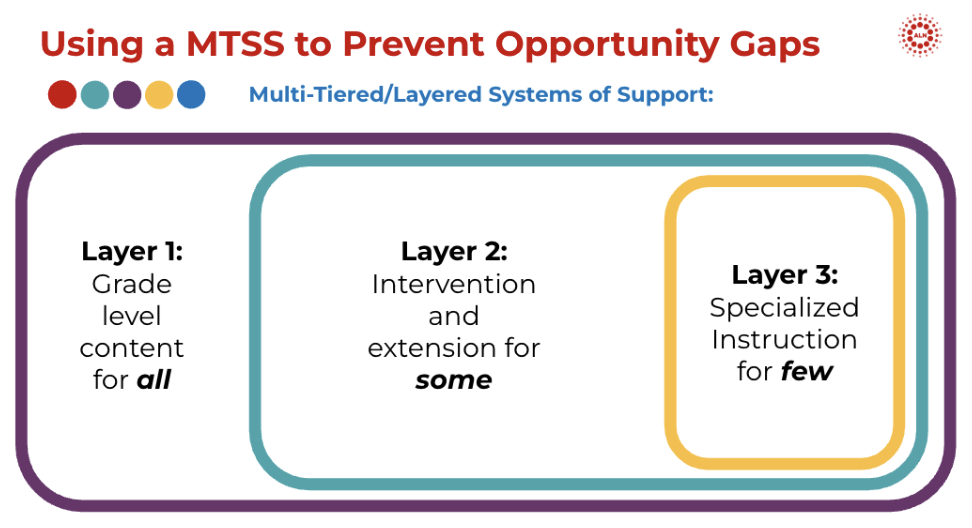
Multi-Tiered Systems of Support (MTSS) is a framework built on matching both the layer and intensity of support to the student's current need. ALN’s approach to supporting all students through access and inclusion can be actualized through the three layers of your MTSS. In Layer 1, all students are provided access to grade level content; this happens throughout all four parts of a balanced math block. For Layers 2 and 3, we know that all classrooms are composed of a dynamic range of learners who require differentiated opportunities to practice and connect just-right concepts and skills everyday. We create space for this work in our math block during Math Menu. To address the needs of all students within the community, Math Menu is also the space for all students to have access to targeted small group instruction or specialized math instruction to close gaps toward grade level instruction. When providing Layer 2 or Layer 3 supports, we think about how to individualize support for individual student growth without removing them from the beneficial classroom learning community. Every student is a part of the community. Every time we remove a student from the classroom, we are disrupting the benefits that all students receive when they work in a diverse community of peers.
What is the difference between a general education classroom and an inclusion classroom?
A general education classroom should be an inclusion classroom. They are one and the same. ALN philosophy understands that ALL general education classrooms should be inclusive classrooms that meet the needs of every student regardless of their identified needs. This means that ALL students are receiving accessible, grade-level content. Some students will receive additional support.
What is the difference between offering inclusive instruction and being in an inclusion classroom?
The traditional inclusion classroom model often conflates where a student is educated with what support they should receive. MTSS is about the quality and match of the intervention, not the room a student sits in.
If a student with a disability is placed in an "inclusion classroom" without providing inclusive, accessible instruction that meets their needs, it is the exact opposite of ALN philosophy and the intent of MTSS.
A traditional belief about inclusion led schools/districts to place a student with a disability in an "inclusion classroom" and believe that the student just being there was inclusion. A more complete understanding of inclusive instruction tells us that students must also be met with inclusive teaching practices that meet their specific needs (cognitive, physical, social/emotional, etc).
Those same traditional beliefs about inclusion led staff to pull students with disabilities out of the general education classroom to provide them with different services. In many cases, this “slower and louder” instruction occurred during core grade level content in the classroom, and did not meet the needs of the students nor did it give students access to grade level instruction. Again, it is not about where the instruction occurs. It is about the quality of inclusive instruction.
Any time we use a term that designates a classroom (general education classroom, inclusion classroom, resource room, self-contained room) based on a tiered/layer of support, we send the unintended message that some spaces are for some types of students, while others are not. This can be interpreted as, general education teachers are not responsible for owning the full range of a student's instructional needs. Classrooms are just that; classrooms where every student belongs.
The core idea is that students would benefit from layers (tiers) of support based on data and current performance, not placed in a classroom targeting one of these tiers. In our communication at ALN, we refrain from using terms that segment classrooms based on tiered support because we believe that all students deserve access to high-quality, inclusive pedagogy in all settings. All classrooms should be general education classrooms for all students, regardless of ability, language and readiness.
What Now?
- Watch this free video: Using All Learners Online (ALO) to Support MTSS in Math in Your School 🎥
- Read this article next: Embracing the "Least Dangerous Assumption" in Inclusive Math Education
- Start your two-week free trial of All Learners Online today!.
- Bring All Learners Network (ALN) to your school or district for embedded professional development.

All Learners Network is committed to supporting pedagogy so that all students can access quality math instruction. We do this through our online platform, free resources, events, and embedded professional development. Learn more about how we work with schools and districts here.
Building Bridges: Helping Students Move Between Concrete, Representational and Abstract Models
Look Back to Look Forward



No Comments Yet
Let us know what you think