.png?width=2000&height=675&name=2023%20ALN_standard-red%20(3).png "All Learners Network logo")

Every other week, our founder and CEO, John Tapper, shares what's on his mind, from his thoughts on math education to what's been inspiring him lately. This is your chance to hear directly from the person who started it all. We believe great ideas are worth sharing, and Founder's Corner is our way of bringing you closer to the heart of All Learners Network (ALN) and the passion that drives everything we do.
In my last column, we looked at what learning math differently looks like when the lesson structure is right. Today I want to zoom in on something smaller: the first ten minutes of class, and why they matter more than most teachers realize.
A boy in the back had his feet on the desk. He was tilted back in his chair, arms crossed, the picture of confidence. When I asked the class what relationships they noticed among the fractions on the board, he was the first to raise his hand.
"3/4 and 6/8 are the same," he said.
"How so?" I asked. "One has a 3 and a 4. The other has a 6 and an 8. What makes them the same?"
He looked puzzled. "You know," he said. "It's obvious."
"I don't think it's obvious," I said. I let the silence stretch.
His feet came off the desk.
I was there at the invitation of his teacher, an eighth-grade math instructor who had noticed what most math teachers notice: a small group of students do most of the talking. She wanted to try something different. She wanted every student to have a chance to contribute. So she invited me in to demonstrate a Launch.
Why the First Ten Minutes Matter
Launches are short opening activities designed around one idea: everyone gets to participate. They connect to the day's main lesson, but the goal isn't to preview content. The goal is for every student to speak up in math class. That matters more than it might sound. Research consistently shows a strong relationship between math identity and math performance, particularly among Black and Latino students. And one of the biggest drivers of math identity is whether students believe they have something to contribute. When they speak up, that belief grows.
Back in the classroom, after the silence, a girl offered that both fractions equal 0.75. Then, from the back of the room, a hand went up slowly. A student who had been invisible until that moment said, quietly, "They both have the same amount of stuff. They're both in the same place on the number line."
The room shifted. You could feel it.
Other students followed. One noticed all the denominators were even. Another said every fraction was divisible by 1/4. Those are very different observations — one is surface-level and the other shows real structural thinking. Both got the same response from me: genuine interest. Both students had contributed. Both walked away having done math in public.
When the Energy in the Room Shifts
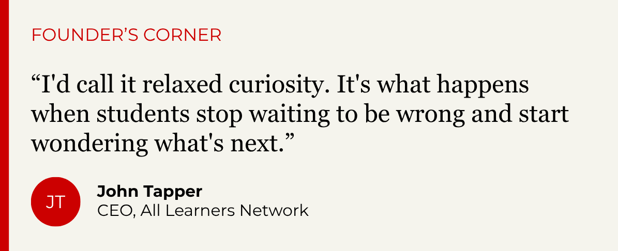
After ten minutes, I handed the lesson back to the teacher. The room had a quality I've come to recognize. I'd call it relaxed curiosity. It's what happens when students stop waiting to be wrong and start wondering what's next.
That's what a good Launch does. It doesn't just warm up the math. It changes who gets to be a mathematician.
This is learning math differently in practice — not a wholesale reinvention of how a lesson is structured, but a deliberate, ten-minute investment at the start of class that shifts who participates, who belongs, and who sees themselves as someone with something to contribute.
The boy in the back learned something that day. Not about fractions, he already knew about fractions. He learned that "obvious" isn't a mathematical argument. That a room full of people thinking together can find things he hadn't seen. That his confidence was a starting point, not a destination.
That's what we're building toward at All Learners Network. Not just better lessons, better conditions. Because when every student gets to speak, something changes in how they see themselves. And that belief, once it takes hold, is very hard to shake.
What Now?
- Interested in hearing more from John? Read this article next: What It Looks Like When Students Learn Math Differently.
- How does stepping outside your comfort zone and trying something new sound? Try a free demo of ALN's AI Math Coach today!
- Explore the High Leverage Concepts and learn how apply them in your classroom.
- Bring ALN to your school or district. Contact us to explore embedded professional development.

All Learners Network is committed to supporting pedagogy so that all students can access quality math instruction. We do this through our online platform, free resources, events, and embedded professional development. Learn more about how we work with schools and districts here.

What It Looks Like When Students Learn Math Differently

The Biggest Mistake We Make in Math Class is Telling Students Too Much



No Comments Yet
Let us know what you think