.png?width=2000&height=675&name=2023%20ALN_standard-red%20(3).png "All Learners Network logo")

Every other week, our founder and CEO, John Tapper, shares what's on his mind, from his thoughts on math education to what's been inspiring him lately. This is your chance to hear directly from the person who started it all. We believe great ideas are worth sharing, and Founder's Corner is our way of bringing you closer to the heart of All Learners Network (ALN) and the passion that drives everything we do.
“You’re the struggling math guy, right?” Amy asked. I was doing a focus group as part of a research study at a school in Hartford when I was approached by one of the teachers.
I laughed. “Is that what you heard? I guess that’s right. I’m interested in how to help people who have trouble with math.”
“Sarah told me that you think anyone can learn math.”
“I’ve worked with a lot of people with a lot of different challenges. So far, that’s always been true. I believe that everyone can learn math. But what makes me believe is that I’ve seen it.” I found it difficult to answer questions like this. I never want to oversell the idea but I always want to be truthful. In a long career teaching math, my experience is that (with proper instruction) everyone can learn math.
The woman looked thoughtful and then her face showed she had made a decision. “Would you meet with my wife? She has always had some trouble with math. It’s getting in the way for her.”
I met Maria in a coffee shop later that week. She was a tiny woman physically, but her presence was not small at all. She struck me, in that first meeting, like someone who didn’t mess around, someone formidable. She was also a little leery of me at first. I could understand why. She was admitting a deep vulnerability to a complete stranger.
“I want to be a nurse,” she told me. “I can’t pass the damn math test. I’ve failed it five times…”
“Wow,” I said. “You are really determined!”
“Yeah,” she replied, “or really stupid. I’m working as a health home aide and it doesn’t pay much. I could do much better as a nurse. Amy told me you can teach math to anyone…”
“Some of that will depend on you. But I think that’s mostly true. Is there any reason why you think you can’t learn math?”
Maria proceeded to tell me the story of her math learning journey. She had done fine in school, she told me, until sixth grade. When I asked her what had happened in sixth grade, she told me that her father had been arrested and that her mother was largely “absent”. When I asked for clarification about that, she told me her mom had struggled with drug addiction and frequently didn’t come home at night.
“It must have been frightening being alone at night at eleven or twelve.”
“I wish!” she said. This wasn’t the response I was expecting.
“You wish you had been alone?” I asked.
“Not really, I guess. But I had two younger sisters I had to take care of. One was five and the other was three. I had to be sure they had something to eat and get them to bed. It was a lot for a kid that age.”
I’ve been in education for a long time. I’ve heard lots of stories about what kids take on that would break your heart. This one was in the top three.
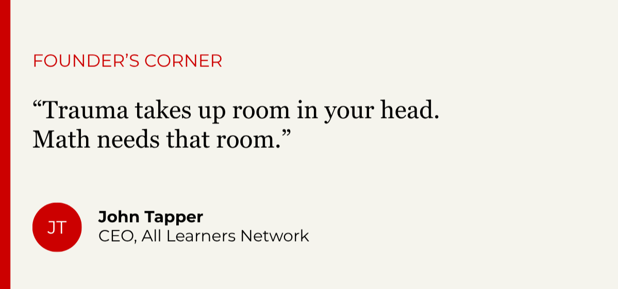
Kids who are managing fear all night don't have bandwidth left for math abstraction at 9 a.m. Maria told me that she had trouble paying attention in class. This was unsurprising, because trauma takes up room in your head. Math needs that room, the capacity for deep thinking, if kids are going to be successful. Trauma impairs emotional regulation, behavioral control, and cognitive function (Nwogbo, 2025). Trauma-exposed students report losing concentration during math class, with some describing crying or inability to focus when traumatic memories intrude. Not knowing what to do in math class, a common problem when you have trouble paying attention, reignites the feelings associated with abandonment and neglect.
Maria’s grades, and the teachers’ opinions of her, dropped and stayed low throughout high school. She had particular difficulty with math. From middle school through high school Maria was placed in the lowest track for math. That placement gave her the clear message that she wasn’t very smart. She was even told, by a teacher, that she was incapable of learning math. He told her she should try to find a job where math wasn’t required. She spent the next decade fulfilling that expectation.
Now that I knew a little more about Maria, we had to make a plan for her to succeed. She did not need another person, however well-intentioned, explaining a series of rules to her. She needed to have a chance to do her own best thinking in an environment which supported her efforts, rather than reinforced the negative view she had developed of her own math ability.
Nwogbo, A. (2025). Trauma, resilience, and math learning: African American students’ perspectives on adverse childhood experiences. American Journal of STEM Education, 12, 23–45. https://doi.org/10.32674/1px6av37
What Now?
- Why Math Menu Matters Even More Right Now — When students carry trauma into the classroom, choice and agency matter more than ever. See how Math Menu creates the conditions where every student can show up and engage.
- Meeting the Needs of All Students — Ready to put this into practice? This free workshop explores how to design instruction that meets students where they are, without lowering expectations.
- Everyone Deserves to Swim — Maria's story is a reminder that exclusion carries real costs. This article explores what inclusive math instruction actually looks like and what it takes to make it possible for every learner.
- Bring ALN to your school or district! — Contact us to explore embedded professional development.

All Learners Network is committed to supporting pedagogy so that all students can access quality math instruction. We do this through our online platform, free resources, events, and embedded professional development. Learn more about how we work with schools and districts here.

What It Looks Like to Struggle with Math: Maria — Part 2
What 1¾ ÷ ½ Tells Us About Teaching Math



No Comments Yet
Let us know what you think