.png?width=2000&height=675&name=2023%20ALN_standard-red%20(3).png "All Learners Network logo")


Students most often struggle in math because they're expected to memorize procedures rather than actually do mathematics. In practice, this means that instead of developing their own understanding, students are taught to parrot the teacher's understanding. Building instruction around student thinking rather than procedural recall is at the heart of everything we do at ALN.
Using an MTSS to Prevent Opportunity Gaps
A Multi-Tiered System of Support (MTSS) is a framework schools use to make sure every student gets the level of help they need, without waiting for them to fail first. It's organized into three layers. Layer 1 is grade-level content for all students, the core instruction everyone receives. Layer 2 provides intervention and extension for some students, offering extra support (or challenge) to those who need more than Layer 1 alone provides. Layer 3 is specialized, more intensive instruction for a few students who need highly individualized support. The key idea is that these layers aren't separate tracks with different content. All students, regardless of readiness, have the right to engage with the same essential mathematical concepts. MTSS exists to prevent opportunity gaps by catching students early and matching the intensity of support to their actual needs, rather than letting gaps widen over time.
The Cycle of Instruction and Intervention: Leveraging the AI Math Coach
At ALN, we use a six-step cycle to support designing high quality instruction and intervention for all learners. We’ve designed our AI Math Coach to help make each step of the cycle more manageable. Each step of the core framework for designing and delivering effective math intervention can be supported by the AI Math Coach.
Steps 1-3: Gather Evidence: Narrow the Content Focus to Widen Access
To gather meaningful evidence:
- Identify strengths first. Always start by finding what a student can do.
- Use High Leverage Concept Assessments (HLCAs) to gather information about students' understanding of high-leverage, grade-level concepts.
- Connect evidence of a student's current conceptual understanding to the HLC Progression. Consider, where do students’ assets fall along that progression? Use the High Leverage Concept Interviews (HLCIs) if you need more information about what a student can do.
- Use the progression document to write math goals that build a pathway of learning toward grade-level concepts.
Using the HLC Progression to guide goal writing:
- Identify where students are currently successful.
- Move one column to the right on the progression. That's often a great next goal.
- Look at the strategy/model chart(s).
- Think about which strategy or model students use and what a good next step looks like.
Step 4 & 5: Plan and Deliver Instruction
High-quality intervention:
- Is focused on core, prioritized math content with clear, manageable goals
- Promotes student discourse
- Engages students in accessible number sense routines and problem solvers that require reasoning and sense-making
- Uses games for practice and reflection
- Relies on continual progress monitoring
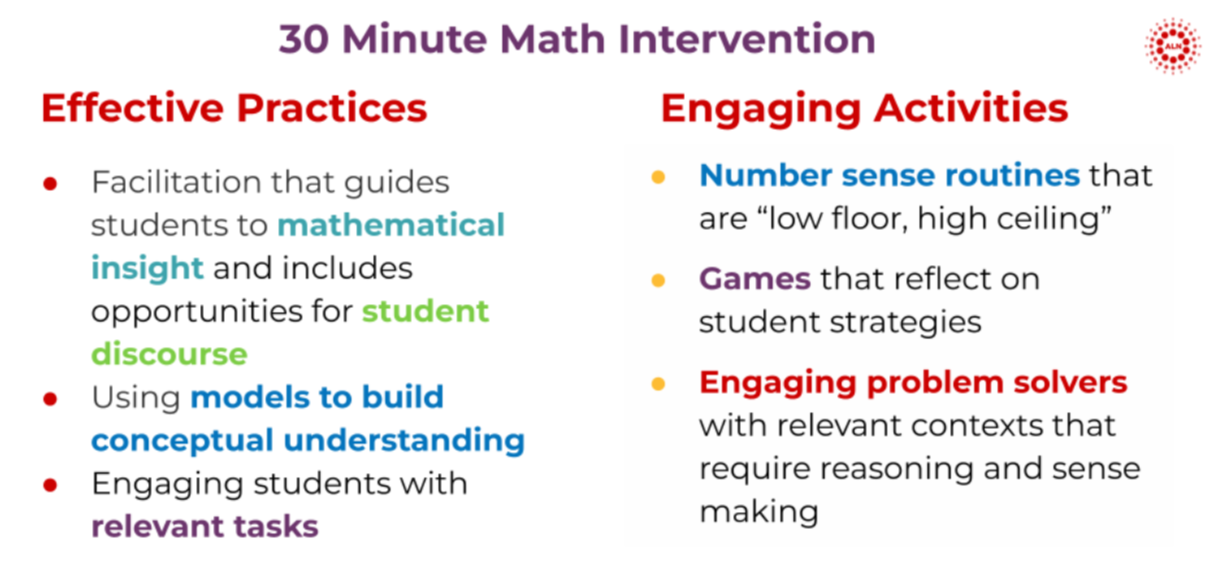
A 30-minute intervention block typically includes a launch or number sense routine, problem solving, and games. Effective practices underpinning all of this includes facilitation that guides students to mathematical insight, opportunities for student discourse, models that build conceptual understanding, and relevant, engaging tasks.
Step 4 & 5: Plan and Deliver Instruction
Gather evidence through formative assessment, student interviews, and classroom observation, and keep asking:
- What are my students' strengths?
- What do they need next?
- What instructional practices best support their growth?
- What models and strategies am I prioritizing?
- How will I know when they've met the goal?
Leveraging AI Math Coach as an Intervention Thought Partner
AI Math Coach is included with ALO Unlimited and offers two assistants:
- Pedagogy Assistant — supports math content, instructional strategies, and resource recommendations.
- Intervention Assistant — helps design intervention blocks and analyzes student work.
What AI Math Coach can do:
- Math Content Support — understand mathematical concepts and how to teach them using student-centered approaches
- Instructional Strategies — activities that promote student discourse, mathematical reasoning, and conceptual understanding
- Resource Recommendations — links to relevant resources from the All Learners Online library
- Student Work Coaching — analyze student work samples to identify misconceptions and suggest next instructional steps
- Connect to High Leverage Concepts — understand how a specific math topic connects to broader mathematical understanding
Tips for Prompting AI Math Coach
- Be specific about your context - grade level, concepts/standards, and students' current understanding.
- Clarify your goal - what you want to accomplish and what kind of support you need.
- Provide relevant details - what you've already tried, available materials or constraints, and examples of student thinking or misconceptions.
- Ask focused questions - one specific question beats several vague ones, and framing questions to elicit student-centered approaches gets better results.
Read more tips for prompting AI Math Coach here
Ready-to-use, copy-and-paste prompt sets are available for different roles:
- Prompts for Special Educators
- Prompts for Classroom Teachers
- Prompts for ELL Teachers / Co-Teaching Partnerships
- Prompts for K–5 Math Interventionists
A sample small-group intervention plan generated with AI Math Coach typically includes a clear goal, engaging tasks, a plan for progress monitoring and formative assessment, and built-in differentiation. For example, a benchmark-based goal drawn straight from the Grade 4 HLC Progression for Multiplicative Reasoning, paired with accessibility supports like chunked, step-by-step directions and visual models for a student with an IEP accommodation.
Putting It All Together: A Reflection
Planning for intervention can be a lot of steps! AI Math coach can help you identify key math concepts and progressions at your grade band to target during interventions and write goals based on student assets. It can also build you an intervention plan full of engaging and relevant resources including number sense routines, games, problem solvers and closure opportunities.
Access the Core Resources, Launch Library, Main Lesson Library, Math Menu Library, and AI Math Coach directly inside All Learners Online.
What Now?
- What Does an Intervention Cycle Look Like? — See the six-step cycle in action. This article walks through what each step looks like in a real classroom setting.
- Try a Free Demo of AI Math Coach — See exactly how AI Math Coach supports intervention planning before you commit. No experience required!
- Defining Common Abbreviations at ALN — New to ALN's language? This quick reference breaks down the abbreviations and terms used throughout this article and across our work.
- Writing Effective Prompts for Your AI Math Coach — The more specific your prompt, the better your results. Learn how to get the most out of every AI Math Coach conversation.
- Bring All Learners Network to your school or district — Ready to build this cycle into your system? Explore our embedded professional development and bring ALN directly to your team.

All Learners Network is committed to supporting pedagogy so that all students can access quality math instruction. We do this through our online platform, free resources, events, and embedded professional development. Learn more about how we work with schools and districts here.

Meet your New Partner in Math Intervention: The AI Math Coach Intervention Assistant

Writing Effective Prompts for Your AI Math Coach



No Comments Yet
Let us know what you think