.png?width=2000&height=675&name=2023%20ALN_standard-red%20(3).png "All Learners Network logo")

Every other week, our founder and CEO, John Tapper, shares what's on his mind, from his thoughts on math education to what's been inspiring him lately. This is your chance to hear directly from the person who started it all. We believe great ideas are worth sharing, and Founder's Corner is our way of bringing you closer to the heart of All Learners Network (ALN) and the passion that drives everything we do.
The conditions that make learning possible don't start in a fifth-grade classroom. They don't start with fractions, number lines, or multiplication tables.
Step into a preschool and the first thing you notice is that the room is alive. Children are building and exploring, painting and counting, playing pretend and make-believe. It's the kind of organized chaos that takes a skilled teacher to hold together.
The Instinct We Need to Question
On this particular morning, that teacher was Nancy. She and I were working our way through math assessments, asking children one by one to join us at a table, recite the number sequence as far as they could, and count a small pile of colored puff balls.
Some could count quite high. Some knew only a few numbers. Many didn't yet have one-to-one correspondence, the ability to touch each object as they counted it. These children would happily wag their fingers at the pile and, no matter how many objects were there, announce: "One-two-three-four-five!"
We recorded what they told us and reminded them they were awesome. In preschool, we were never disappointed by what a child could do. They were where they were, and that was just fine.
One particularly shy little girl caught my attention. Suki. She could say her numbers to ten, then slipped into the "firteen, firteen" that many four-year-olds land on when navigating thirteen and fourteen. When she finished, she headed back to the part of the room with the play kitchen, the table, the food, and the utensils.
Nancy watched her go.
"Suki spends a lot of time in housekeeping," she said quietly. "I need to get more math into housekeeping."
She was talking to herself. An offhand remark. But it stopped me.
In thirty years of working in K-12 education, my instinct had always been the opposite. When a student wasn't ready for the math I thought was important, I would find ways to coax them toward what I had planned. The assumption was that the student needed to meet the curriculum.
Nancy had it the other way around. If Suki were in housekeeping, the math had to go to Suki. The teaching had to respond to the child, not the other way around.
Nancy's offhand remark landed differently than she intended. It wasn't a teaching strategy or a philosophy. It was just the obvious next step: meet Suki where she is. But for me, it reframed something I'd been getting wrong for thirty years.
The Curriculum Should Meet the Student
The shift we need is about something more fundamental: the belief that every child who walks into a classroom arrives with years of experience, curiosity, and capacity. The school's job isn't to sort children by what they already know. It's to be ready for whoever actually shows up.
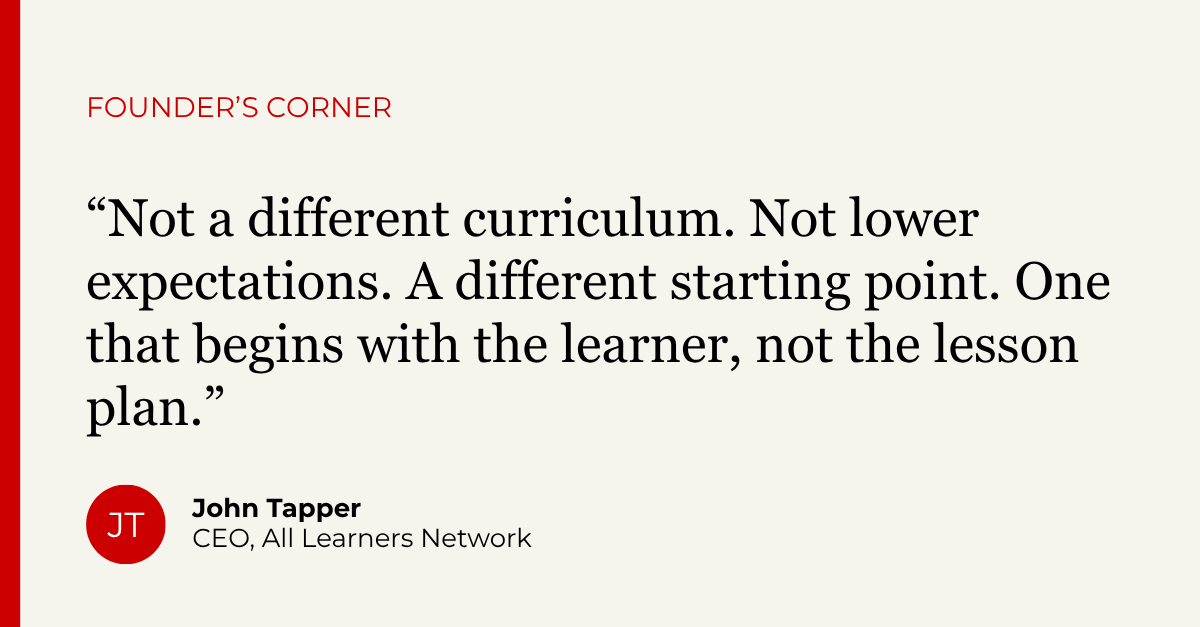
This is what it means for the curriculum to meet the student, not the other way around. Not a different curriculum. Not lower expectations. A different starting point. One that begins with the learner, not the lesson plan.
Because the question was never whether Suki was ready for the math. The question was whether the math was ready for Suki.
What Now?
- Interested in hearing more from John? Read this article next: Beyond the Right Answer: The Conditions that Lead to Real Understanding.
- Watch a first-hand example of meeting a student where they are in this 2nd Grade Student Interview.
- Dive deeper into today's theme with the a free download of the All Learners Network Lesson Structure.
- Bring ALN to your school or district. Contact us to explore embedded professional development.

All Learners Network is committed to supporting pedagogy so that all students can access quality math instruction. We do this through our online platform, free resources, events, and embedded professional development. Learn more about how we work with schools and districts here.

Beyond the Right Answer: The Conditions that Lead to Real Understanding
What 1¾ ÷ ½ Tells Us About Teaching Math


No Comments Yet
Let us know what you think