.png?width=2000&height=675&name=2023%20ALN_standard-red%20(3).png "All Learners Network logo")

Every other week, our founder and CEO, John Tapper, shares what's on his mind, from his thoughts on math education to what's been inspiring him lately. This is your chance to hear directly from the person who started it all. We believe great ideas are worth sharing, and Founder's Corner is our way of bringing you closer to the heart of All Learners Network (ALN) and the passion that drives everything we do.
Learning math differently isn’t about lowering expectations. It isn’t about simpler problems or slower pacing. It’s about creating the conditions where every student, including the ones who have been labeled, limited, or written off, can show you what they already understand.
Timmy showed me that more clearly than anyone.
Timmy was in first grade, and he already had a reputation.
He couldn’t sit still. He disrupted the morning meeting. His clothes were disheveled. He had trouble articulating "w" for "r" substitution - a common issue for many young children and sometimes flapped his hands. His IEP goals were modest: learn math facts to 20.
From the outside, Timmy did not look like a strong mathematical thinker.
But he was.
Sometimes the Math is Already There
When I started working with him as a math interventionist, it became clear quickly that Timmy already knew the combinations to ten, could arrange number cards in order almost absently, and could tell me instantly how many counters were missing from a ten-frame without breaking from whatever he was building.
I began to wonder why anyone thought this child needed intervention.
Then I wrote: 71 − 35. He signed, picked up a marker, and subtracted the digits independently – ones from ones, tens from tens – arriving at 44. He knew the procedure, but he didn’t know what subtraction meant.
So I tried something different.
I asked, "Do you visit your grandma?" He did. He called her Nonna.
"Think about driving to Nonna's house,” I said. “It's 71 miles away. On the way, you stop when you're 35 miles from her house. How much farther do you have to go?"
"Why did I stop?" he asked. Then, without missing a beat, he said, "We were getting chips."
Then he solved it entirely in his head — counting up from 35 to 71, arriving at 36. Correct, confident, and completely without the procedure he'd just failed to apply.
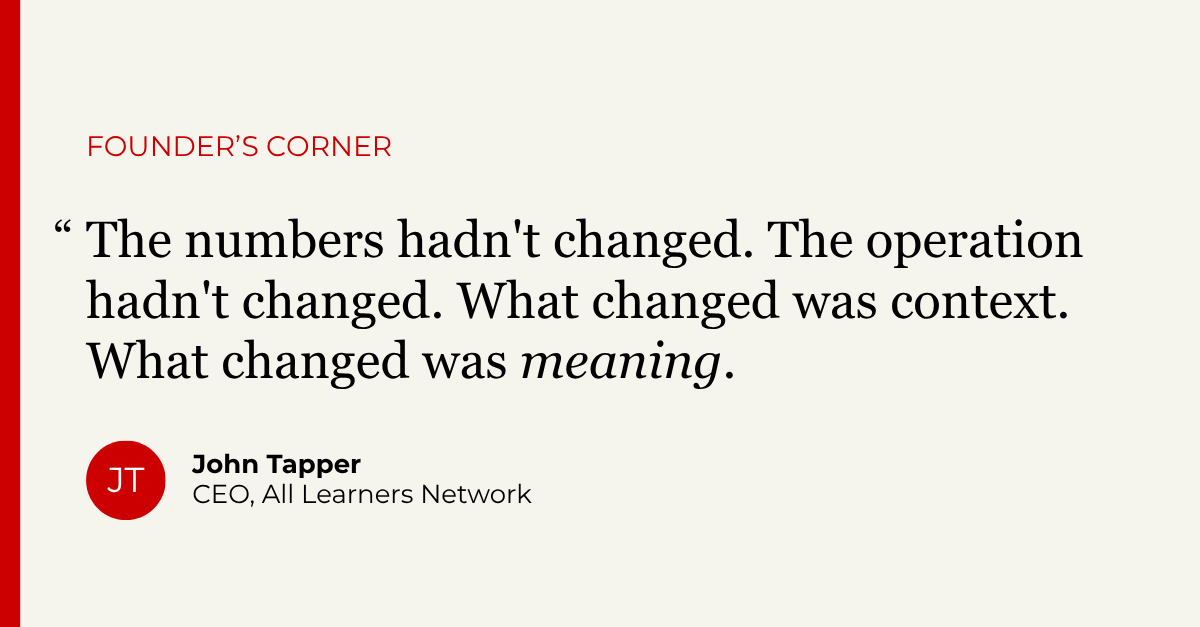
The numbers hadn't changed. The operation hadn't changed. What changed was context. What changed was meaning.
By February, Timmy could accurately add and subtract three-digit numbers in his head. When the special education teacher asked what his IEP goals should be for the following year, I had one answer: whatever other second graders do.
For Timmy, when subtraction was a procedure to remember and replicate, he shut down. When subtraction was about getting chips on the way to Nonna's house, he could think. And when he could think, the mathematics was already there.
Asking the Right Question in the Right Context
This is what learning math differently looks like from the inside.
Not lowering expectations because a child cannot sit still. Not assuming a disheveled first-grader with articulation problems cannot think mathematically. Not drilling procedures until a student either complies or gives up.
It looks like asking the right question, in the right context, so a student can show you what they already understand. The mathematics was already there in Timmy, just waiting to be uncovered, not installed.
Every student has a place like Nonna’s house. Our job is to find it.
What Now?
- Timmy didn't need to slow down; he needed the right road map. Use our K-8 HLC Maps and Learning Progressions to identify the foundational concepts your students actually need to master.
- A great math task starts with a great hook. Read Why Launch to explore how rich, contextual situations invite every student into the problem.
- If Timmy's story resonated with you, explore Understanding MTSS vs. Tiered Classrooms to see how support systems can empower students rather than box them in.
- Bring ALN to your school or district. Contact us to explore embedded professional development.

All Learners Network is committed to supporting pedagogy so that all students can access quality math instruction. We do this through our online platform, free resources, events, and embedded professional development. Learn more about how we work with schools and districts here.

What 1¾ ÷ ½ Tells Us About Teaching Math

Beyond the Right Answer: The Conditions that Lead to Real Understanding



No Comments Yet
Let us know what you think